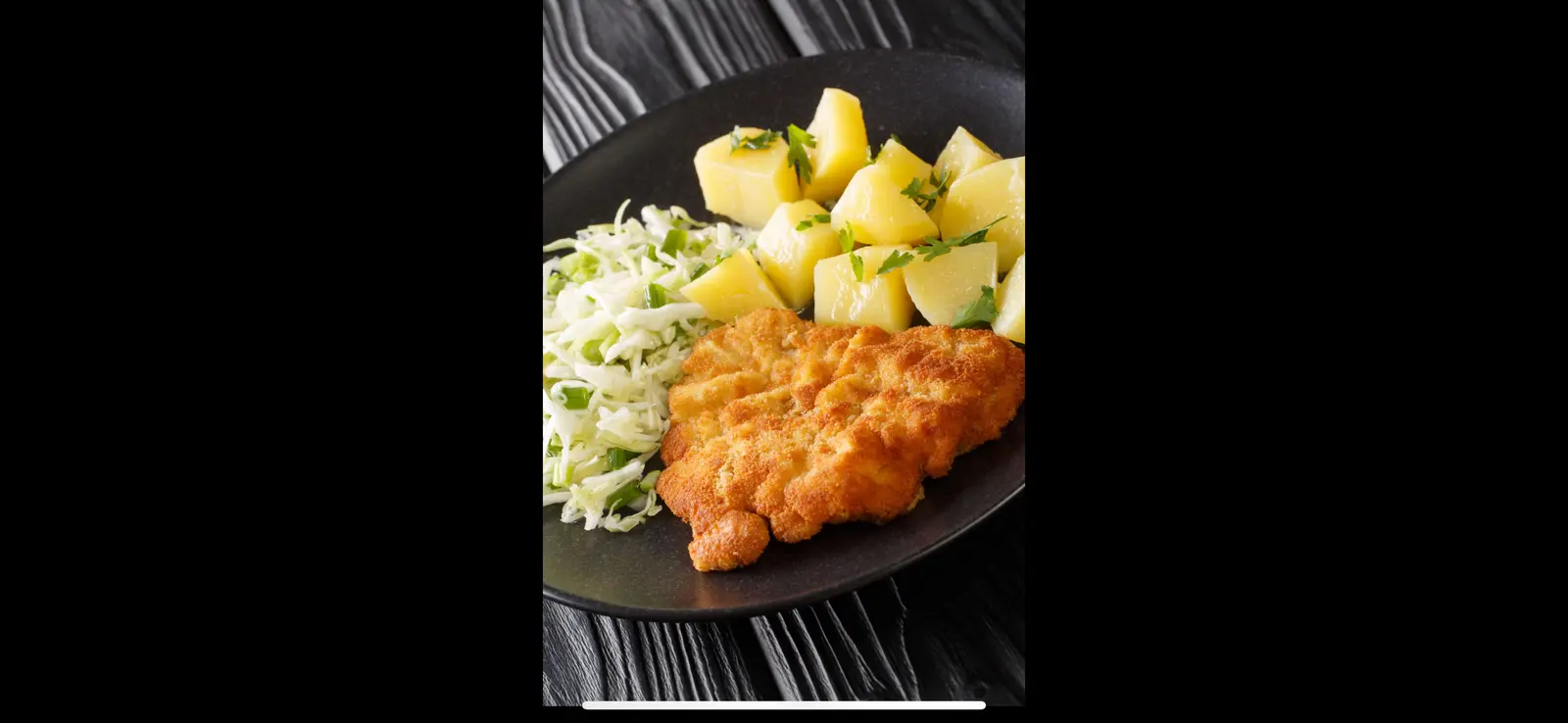
Kotlet schabowy
Kotlet schabowy — the Polish schnitzel — is Poland's national pork dish. A pork loin slice is pounded thin, coated in flour, egg, and breadcrumbs, then fried in lard or oil until golden, crispy, and evenly cooked through. Unlike Wiener Schnitzel (veal), the Polish kotlet has always been pork and remains the Sunday dinner of millions of families. Served classically with boiled potatoes and sautéed sauerkraut. The crispy crust against the juicy pork interior is the defining contrast of the dish. Polish cooks know that lard delivers a flavor oil cannot replicate — a change mourned by many since lard disappeared from modern kitchens.
Rich in protein
Filling and nutritious
Fermented
Contains fermented ingredients
Traditional recipe
Authentic taste
Ingredients 4 servings
- 4 boneless pork loin chops (~180–200 g each, ~1.5–2 cm thick) — about 800 g total
- 1 tsp fine salt for the pork
- 0.5 tsp freshly ground white pepper
- 200 ml whole milk for the tenderizing soak (the Polish trick)
- 80 g all-purpose flour for breading
- 3 large eggs beaten with 1 tbsp milk and a pinch of salt
- 200 g fine fresh breadcrumbs (homemade from day-old bread is best) or panko
- 80 g lard (traditional) OR 100 ml neutral sunflower oil for frying
- 30 g unsalted butter for the finishing baste
- 1 lemon, cut into wedges (modern garnish)
- For dill potatoes: 800 g floury potatoes peeled + 30 g butter + 1 small bunch chopped dill + salt for the cooking water
- For sautéed sauerkraut: 400 g drained sauerkraut + 1 small onion finely chopped + 1 tbsp lard + 100 ml water
How to make it
- 1POUND THE PORK: place each pork chop between two sheets of cling film and pound with a flat meat mallet from the centre outward, 30 seconds per side, until the chops are 6–7 mm thick and almost doubled in size — they must be even thickness for uniform cooking; score the fatty rim 3–4 times to prevent curling.
- 2MILK SOAK: pat the pounded chops dry and rub each side with salt and white pepper; place in a shallow dish, pour over 200 ml milk so the chops are mostly submerged, cover and refrigerate 30 minutes (up to 2 hours) — the lactic acid tenderizes the meat without altering the flavour.
- 3SET UP THE BREADING STATION: three shallow plates in a row: plate 1 with 80 g flour; plate 2 with 3 beaten eggs + 1 tbsp milk + a pinch of salt; plate 3 with 200 g fine breadcrumbs; the line-up matters: every chop must travel flour → egg → breadcrumbs without skipping.
- 4BREAD THE CHOPS: lift one chop from the milk, let the excess drip off, and dredge in flour, shaking off the excess — the flour must coat thinly and evenly or the egg won't stick; then dip into the egg, letting it drip 2 seconds, then press firmly into the breadcrumbs on both sides, patting them on so they adhere; set on a plate; repeat for all 4 chops; let them rest 5 minutes — the breading hydrates and binds.
- 5BOIL THE POTATOES: meanwhile, peel 800 g potatoes and cut into 4 cm chunks; place in cold salted water, bring to boil, and simmer 15–18 minutes until fork-tender; drain, return to the pot off heat for 2 minutes to dry, then toss with 30 g butter and chopped dill.
- 6SAUTÉ THE SAUERKRAUT: in a separate pan, melt 1 tbsp lard over medium heat; add 1 finely chopped onion, fry 5 minutes until golden; add 400 g drained sauerkraut and 100 ml water; simmer covered 15 minutes, then uncover and cook 5 minutes more until most of the liquid has evaporated and the kraut is tender; season with a twist of pepper.
- 7FRY THE SCHNITZELS: heat 80 g lard (or 100 ml oil) in a large heavy skillet over medium-high heat until shimmering (175 °C, or a breadcrumb sizzles immediately on contact); fry the chops 2 at a time so the pan isn't crowded, 3–4 minutes per side undisturbed until deeply golden brown and crisp; the internal temperature should reach 70 °C; in the last 30 seconds, add 15 g butter to the pan and tilt to baste the schnitzels — the butter foams brown and gives the breading its iconic Polish-Sunday aroma; transfer to a rack lined with paper towels to drain (NOT a plate, which would steam the bottom soggy).
- 8SERVE IMMEDIATELY: plate each schnitzel alongside a mound of dill potatoes and a heap of sauerkraut; garnish with a lemon wedge if you like (the squeeze brightens the fat); eat with a knife and fork — never just a fork, this is a respect-the-classics dish; the schnitzel should be eaten within 5 minutes of frying for maximum crunch.
Nutritional info
per serving (~350 g)
Estimated nutritional values.
Pairs perfectly with