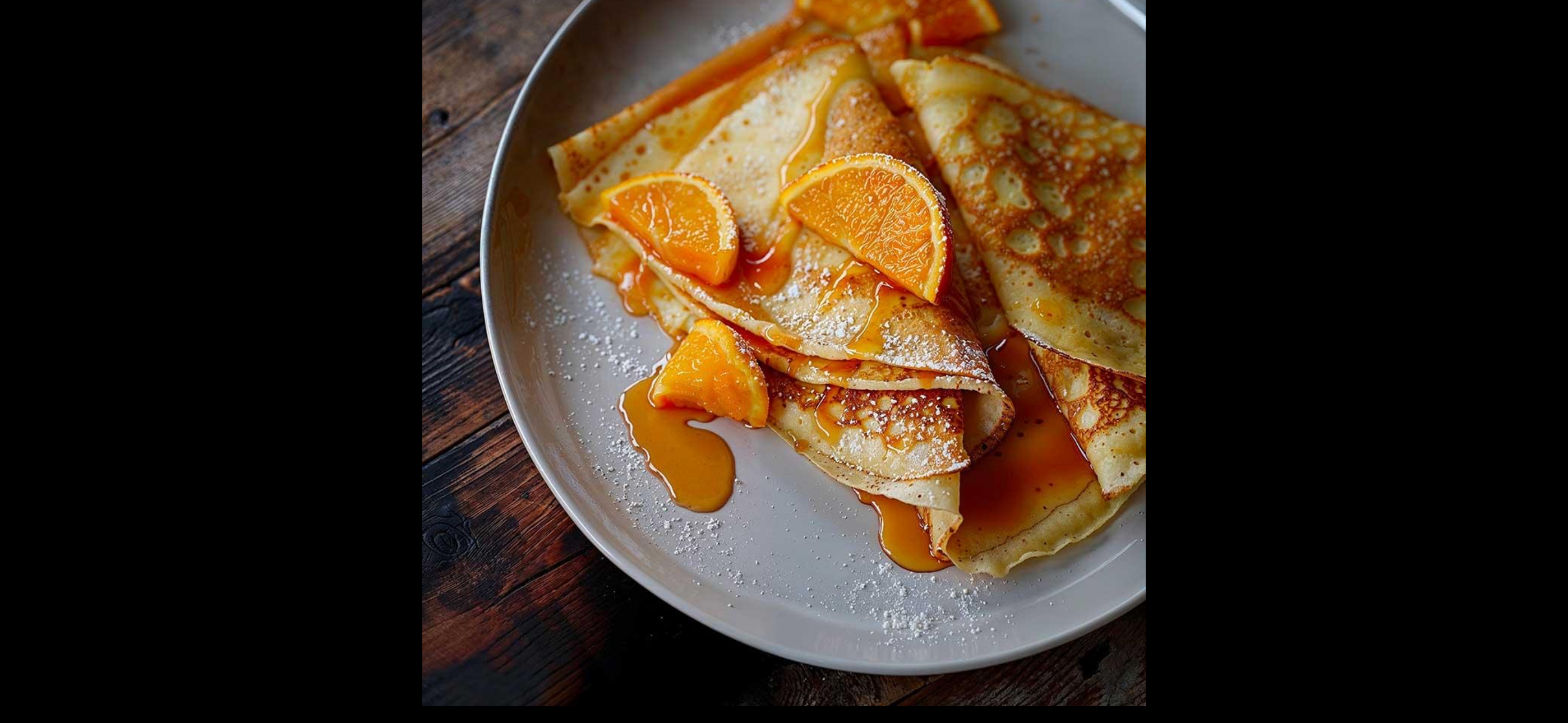
Crêpes
Crêpes sucrées are the French form of thin pan-poured batter — the sweet wheat-flour, egg and milk version that spread from Brittany across France in the 19th century. The older cousin is the Breton galette, made from buckwheat flour and used as a savoury wrapper for ham, cheese and egg. The pastry-shop crêpe, by contrast, lives in sweet flavours: sugar, lemon, jam, Nutella. In France, the 2nd of February is La Chandeleur — the day of crêpes. Tradition has it that flipping a crêpe in mid-air with one hand while holding a coin in the other will bring prosperity for the year. Today crêpes are at once street food (the pavement vendors with their tub of butter), pastry-shop dessert (Crêpes Suzette, flambéed with Grand Marnier) and a quick supper at home when the fridge has little to offer.
Thin batter, swirled in the pan
Wheat flour, eggs, milk and a thread of brown butter
Rest at least 30 minutes
The gluten settles; crêpes go thin and soft, not rubbery
Beurre noisette
Browned butter gives the pastry-shop flavour you can taste when it's missing
Sugar and lemon
The Parisian street-stand classic — sucre-citron, folded in quarters
Ingredients 4 servings
- 250 g plain flour (T45 or T55), sifted
- 4 large eggs, at room temperature
- 500 ml whole milk (or 350 ml milk + 150 ml water for lighter crêpes)
- 50 g unsalted butter, melted until it browns to beurre noisette
- 30 g sugar and a good pinch of fine salt
- 1 tbsp dark rum or orange-flower water (or 1 tsp vanilla extract)
- Extra butter for the pan (~30 g, kept on a brush)
- To serve: caster sugar, lemon wedges, optionally jam, Nutella or sliced banana
How to make it
- 1Melt the 50 g of butter in a small saucepan over medium heat and keep cooking until it smells nutty and turns deep gold, then strain into a bowl leaving the dark sediment behind — that's beurre noisette, the signature flavour of bakery-grade crêpes.
- 2Sift the flour and salt into a large bowl, make a well in the middle, crack in the eggs and add a third of the milk with the sugar, then whisk from the centre outwards drawing in the flour until you have a thick smooth paste with no lumps, thin with the rest of the milk in a slow stream and finally add the cooled brown butter and the rum; the batter should be the consistency of single cream.
- 3Cover and rest the batter in the fridge at least 30 minutes, ideally an hour — the gluten settles and the crêpes turn out thin and flexible rather than elastic.
- 4Heat a 22–24 cm non-stick pan or crêpière over medium-high heat, brush with a very thin film of butter and pour in about 50 ml of batter, immediately swirling so it covers the base in a thin disc, then cook 50–60 seconds until the edges lift and the underside is lacy golden, flip with a thin spatula (or a quick toss of the pan) for another 25–30 seconds, slide onto a plate and cover with a clean cloth — carry on, brushing the pan with a little butter every one or two crêpes, until the batter is gone.
- 5Serve warm, scattered with caster sugar and a squeeze of lemon, folded into quarters — the Parisian street-stand alternatives are sucre, sucre-citron, fruit jam, Nutella, or banana with Nutella.
Nutritional info
per serving (~350 g)
Estimated nutritional values.
Pairs perfectly with