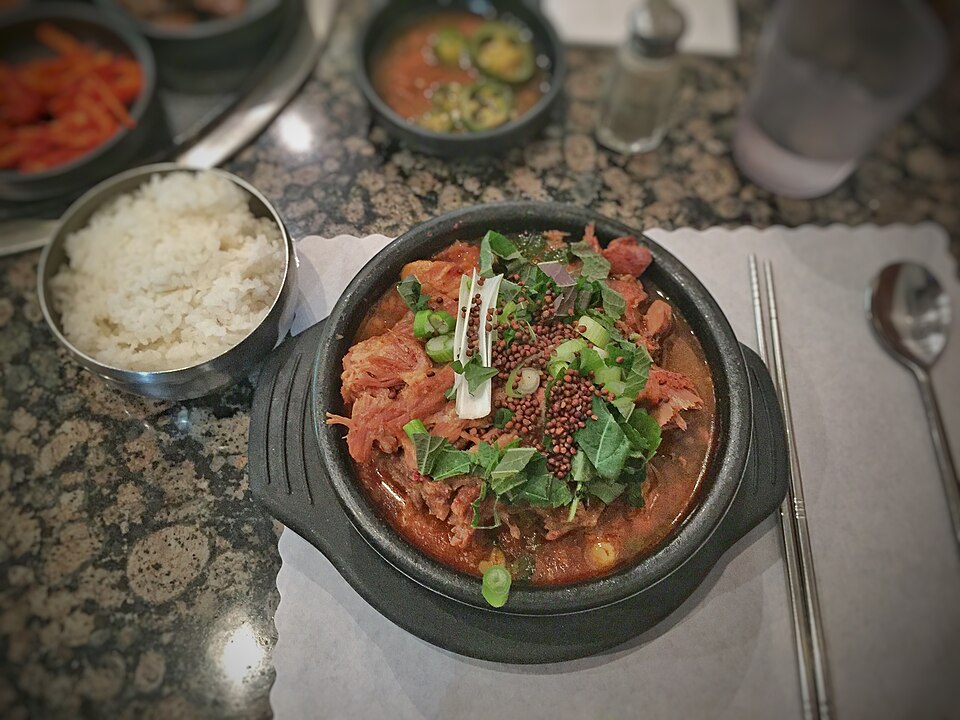
Gamjatang
Gamjatang comes from the working-class kitchens of 20th-century industrial Korea, where pork neck bones — a cheap cut otherwise often discarded — were transformed through long simmering into something worthy of a hearty meal. The name literally means 'potato stew', though the potato is only one of many ingredients; some say the name actually comes from 'gamjappyeo', the part of the pig's neck where the bone sits, not from the vegetable. The dish's success lies in patience: the bones need to simmer long enough that the cartilage pulls away easily, but the potatoes must go in late enough that they don't dissolve into mush. The perilla leaves, added right at the end, provide the herbal counterpoint an otherwise gochujang-and-fatty-meat-dominated soup needs — a hearty dish traditionally eaten late, after work or after a night of drinking.
Pork neck bones
Simmered for hours until the meat falls off
Whole large potatoes
Soften without falling apart
Perilla leaves
A herbal, faintly anise-like note
Eaten from a shared pot
Served still boiling, right at the table
Ingredients 4 servings
- 1.2 kg meaty pork neck bones
- 2 l water
- 1 onion, quartered
- 6 garlic cloves, whole, plus 4 finely chopped
- 3 cm fresh ginger, sliced
- 2 tablespoons fermented soybean paste (doenjang)
- 3 tablespoons chile paste (gochujang)
- 2 tablespoons chile powder (gochugaru)
- 2 tablespoons soy sauce
- 1 tablespoon ground perilla seeds (or ground sesame)
- 4 large Yukon Gold potatoes, peeled and halved
- 3 spring onions, cut into 3 cm pieces
- 8 perilla leaves (or basil), roughly torn
- Salt and black pepper, to taste
How to make it
- 1PARBOIL THE BONES: put the pork bones in a large pot, cover with cold water, bring to a boil and boil for 3 minutes, then drain and rinse both the bones and the pot — this removes the impurities that would cloud the broth.
- 2MAKE THE BASE BROTH: return the cleaned bones to the pot with the fresh 2 litres of water, the onion, whole garlic and ginger; bring to a boil, then simmer gently, partially covered, for 1 hour 30 minutes, skimming off foam occasionally.
- 3MAKE THE SPICY PASTE: stir together the doenjang, gochujang, gochugaru, soy sauce, chopped garlic and perilla powder in a small bowl until smooth.
- 4ADD THE POTATOES: remove the onion and ginger from the broth, stir in the spicy paste until fully dissolved, then add the potatoes and simmer 20 minutes, until nearly tender but still holding their shape.
- 5FINISH: add the spring onions and simmer 10 minutes more, until the meat on the bones is very tender and pulls away easily with a fork; taste and adjust with salt and pepper.
- 6SERVE BOILING: tear the perilla leaves over the top just before serving, bring the pot to the table while still bubbling and serve with steamed white rice alongside.
Nutritional info
per serving (~400 ml)
Estimated nutritional values.
Pairs perfectly with