Argentine Alfajores
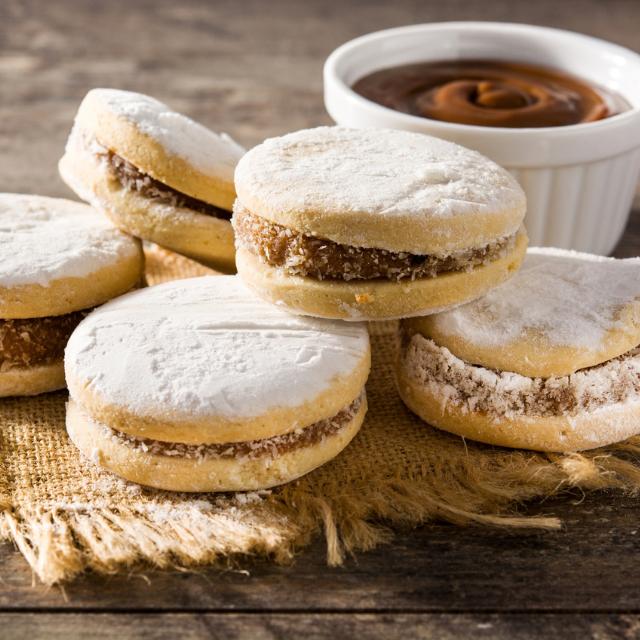
Alfajores have Arabic origins, the word coming from al-hasú, an Andalusian Arabic term for stuffed sweets. The recipe traveled from Muslim Spain to the medieval Iberian Peninsula, and later to South America with Spanish colonization, where each country adapted it with its own style. In Argentina, alfajores evolved into the dulce de leche version, a slow-caramelized milk cream that became a symbol of national culinary identity. Made industrially by dozens of brands or handcrafted in neighborhood bakeries, alfajores are considered Argentina's national snack, consumed annually in huge quantities and exported as a typical souvenir for tourists.
Tender cookies
Delicate dough of cornstarch and flour that melts in your mouth.
Thick dulce de leche
A thick filling of slow-caramelized milk.
Rolled in coconut
The edges are rolled through shredded coconut.
Popular gift
Sold in boxes as a traditional Argentine souvenir.
Ingredients 4 servings
- 150g cornstarch
- 100g flour
- 100g soft butter
- 70g powdered sugar
- 3 egg yolks
- 1 tsp baking powder
- 1 tsp vanilla extract
- 400g dulce de leche
- 150g shredded coconut
- A pinch of salt
How to make it
- 1PREPARE DOUGH: Beat the soft butter with powdered sugar until creamy, add the egg yolks and vanilla.
- 2FOLD IN DRY INGREDIENTS: Add the cornstarch, flour, baking powder and salt, mix until a smooth dough forms.
- 3REST THE DOUGH: Wrap the dough in film and refrigerate for 30 minutes.
- 4ROLL AND CUT: Roll the dough to 5mm thickness and cut circles with a glass or round cutter.
- 5BAKE: Bake the cookies for 8-10 minutes at 170°C, until the edges turn lightly golden, without browning too much.
- 6COOL: Let the cookies cool completely on a rack.
- 7ASSEMBLE: Spread a thick layer of dulce de leche on half the cookies and cover with the remaining cookies.
- 8FINISH: Roll the filled edges through shredded coconut before serving.
Nutritional info
per serving (~350 g)
Estimated nutritional values.
Pairs perfectly with