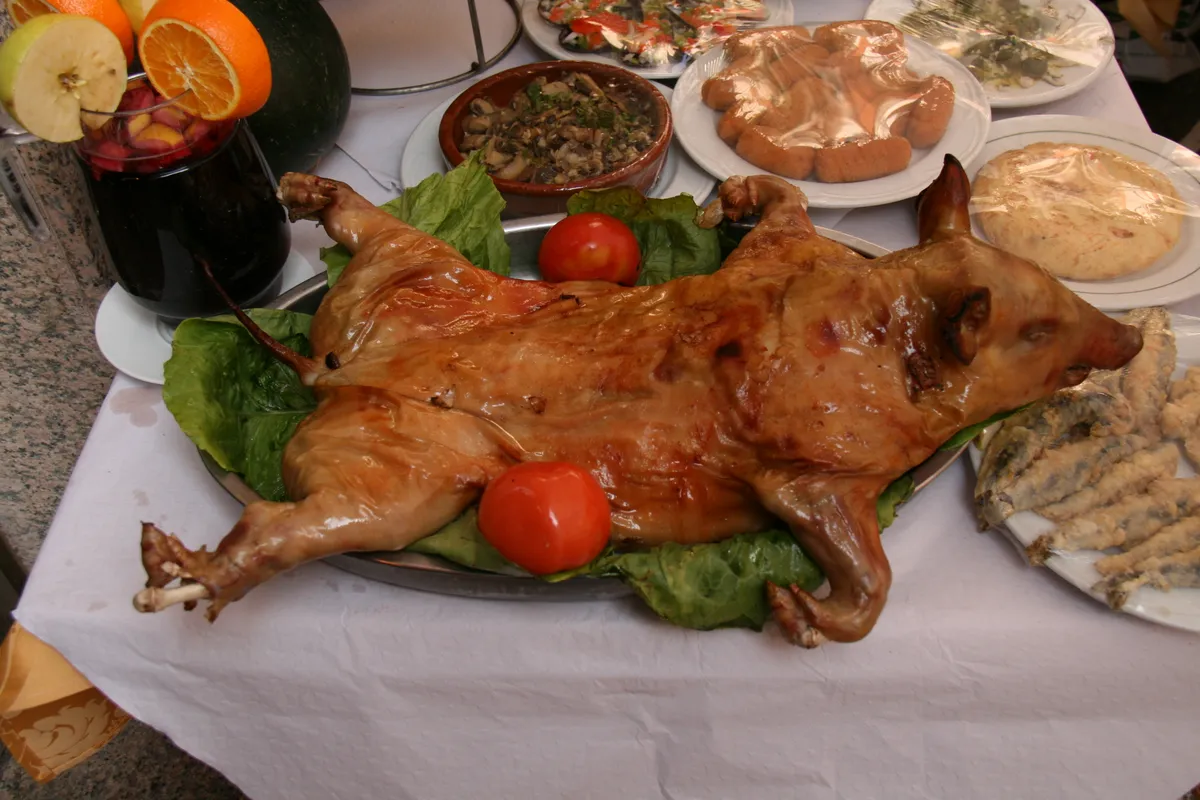
Cochinillo Asado
Cochinillo asado has deep roots in Castile, particularly in Segovia, where the tradition of roasting milk-fed piglets in stone wood-fired ovens dates back to the Middle Ages. The recipe's simplicity — just salt, water and lard — reflects traditional Castilian cooking, where exceptional-quality ingredients need little embellishment, and the quality of the meat, coming from very young animals fed exclusively on milk, is what truly matters.\n\nThe ritual of carving with the edge of a ceramic plate, then smashing it on the floor, is a tradition kept alive by Segovia's historic restaurants, such as Mesón de Cándido, as a theatrical demonstration of the perfect texture: if the skin doesn't snap cleanly on the first press, the piglet wasn't roasted properly. The Segovia cochinillo promotion consortium today certifies the farms that follow the traditional breeds and rearing methods.
Carved with the edge of a plate
In Segovia, innkeepers traditionally carve the roast piglet with the edge of a ceramic plate, proof of how crackling-crisp the skin is.
Slow-roasted, then blasted with heat
Hours at low temperature tenderize the meat, and a final blast of high heat turns the skin into a shattering crust.
Only milk-fed piglet under 21 days
The Segovia Consortium's rules require the piglet to be under three weeks old and fed exclusively on its mother's milk.
Seasoned with almost nothing
Just salt, water and lard — the meat and skin are left to speak for themselves, with no marinade or elaborate sauce.
Ingredients 4 servings
- 1 whole milk-fed piglet, 4-4.5kg (ordered from the butcher)
- 2 tbsp coarse salt
- 500ml water
- 100g pork lard
- 4 garlic cloves, crushed
- 2 bay leaves
- 1 tsp black peppercorns
- 2 tbsp olive oil
- 1 lemon, sliced, for serving
How to make it
- 1The day before, rub the piglet, inside and out, with coarse salt, crushed garlic, bay leaves and peppercorns, then refrigerate it overnight.
- 2Take the piglet out of the fridge an hour before roasting, so it comes to room temperature.
- 3Preheat the oven to 150°C and set the piglet skin-side up in a large clay or metal roasting dish, with the water poured underneath.
- 4Roast slowly for about two and a half hours, basting the skin occasionally with melted lard, until the meat turns extremely tender.
- 5Raise the oven temperature to 220°C for the final 20 to 25 minutes, until the skin puffs up and turns as brittle as glass.
- 6Let the piglet rest for 10 minutes before carving.
- 7Finally, cut it into portions by pressing the edge of a ceramic plate into the skin, in the traditional Segovian style, and serve alongside lemon slices.
Nutritional info
per serving (~350 g)
Estimated nutritional values.
Pairs perfectly with