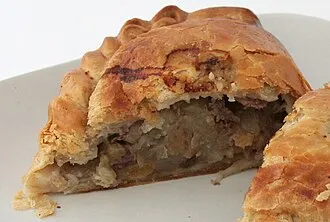
Cornish Pasty
The Cornish pasty is the culinary symbol of the Cornwall region, originally created as a practical lunch for 18th-century tin miners. Its distinctive shape, with a thick twisted edge, allowed miners to hold the pasty by that crust with hands dirtied by work, eating the rest without contaminating the filling, with some accounts saying the crust edge was discarded afterward. European regulation granted the Cornish pasty Protected Geographical Indication status, meaning only those made in Cornwall following the traditional recipe can carry the name. The classic filling remains unchanged across generations — raw beef, potato, swede and onion, slow-cooked inside the folded pastry without being pre-cooked separately.
Mining origin
Created as a portable lunch for miners
Crescent shape
Filling sealed inside a folded pastry
Meat and vegetables
Beef, potato, swede and onion
Baked whole
Baked until the crust turns a sturdy gold
Ingredients 4 servings
- 500 g beef skirt steak, finely diced
- 400 g potatoes, small cubes
- 200 g swede (rutabaga), small cubes
- 1 onion, finely chopped
- 500 g savoury shortcrust pastry
- 1 egg, beaten, for brushing
- Salt and black pepper
- 1 tbsp chopped parsley
- Butter for greasing the tray
How to make it
- 1Cut the beef, potatoes, swede and onion into small, even cubes.
- 2Mix everything together in a large bowl with salt, pepper and parsley.
- 3Roll out the pastry and cut into large circles, about 20 cm in diameter.
- 4Place a generous portion of filling on one half of each pastry circle.
- 5Fold the pastry over the filling to form a crescent and seal the edges by twisting them in the traditional crimped pattern.
- 6Transfer the pasties to a lined tray and brush with beaten egg for a glossy crust.
- 7Bake at 200°C for 15 minutes, then at 170°C for a further 40 minutes, until the crust is golden and the meat is tender.
Nutritional info
per serving (~350 g)
Estimated nutritional values.
Pairs perfectly with