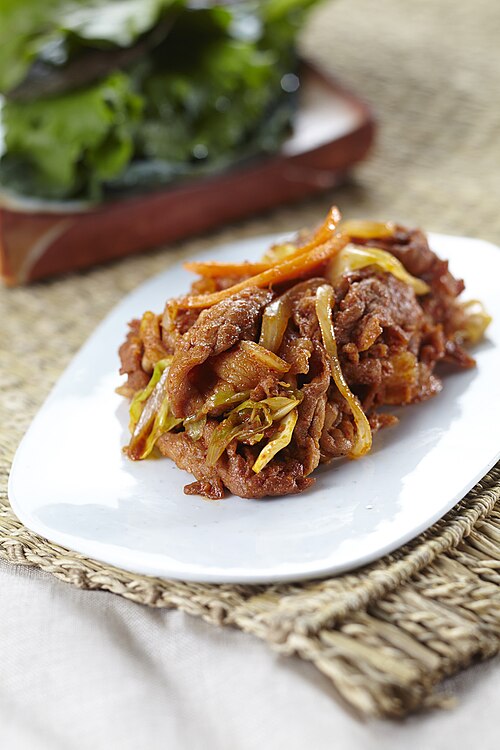
Jeyuk Bokkeum
Jeyuk bokkeum spread from Korean home kitchens in the years after the Korean War, when pork — cheaper than beef — became the main protein source for many families. The name simply means 'stir-fried pork', but the dish holds a special place: it's among the few meat dishes Koreans cook at home just as often as they order it at a restaurant. Slice thickness matters as much as the marinade: cut too thick and the edges never get the chance to caramelize before the inside overcooks; cut right — paper-thin, almost translucent — the meat picks up that glossy sweet-spicy crust in just a few minutes over high heat. The grated pear in the marinade plays the same role it does in galbi, tenderizing the meat through natural enzymes rather than long marinating time. It's traditionally eaten wrapped in lettuce or perilla leaves, with raw garlic and soybean paste — a cooling contrast to the heat in the meat.
Thin-sliced pork
Shoulder or belly, cut paper-thin
Sweet-spicy marinade
Gochujang, gochugaru and grated pear
Seared over high heat
Caramelizes in just a few minutes
Wrapped in lettuce
With raw garlic and soybean paste
Ingredients 4 servings
- 600 g pork belly or shoulder, sliced very thin (2-3 mm)
- 1 small onion, blended to a purée
- 4 tablespoons gochujang (chile paste)
- 2 tablespoons gochugaru (chile flakes)
- 3 tablespoons brown sugar
- 3 tablespoons mirin
- 1 tablespoon soy sauce
- 1/2 Asian pear, grated
- 3 cm fresh ginger, grated
- 6 garlic cloves, finely chopped
- 2 tablespoons vegetable oil, for frying
- 1 tablespoon toasted sesame seeds, to garnish
- 2 spring onions, thinly sliced, to garnish
- Lettuce or perilla leaves, to serve
- Steamed white rice, to serve
How to make it
- 1MAKE THE MARINADE: stir together the puréed onion, gochujang, gochugaru, brown sugar, mirin, soy sauce, grated pear, ginger and garlic in a large bowl until smooth.
- 2MARINATE THE PORK: add the pork slices to the marinade, mix well by hand so every piece is coated, then cover and refrigerate for at least 2 hours, ideally overnight.
- 3BRING TO ROOM TEMPERATURE: take the meat out of the fridge 30 minutes before cooking, so it sears evenly and doesn't shock the pan cold.
- 4HEAT THE PAN: set a cast-iron or non-stick skillet over high heat, add the oil and let it heat until almost smoking.
- 5FRY IN BATCHES: lay only as many slices in the pan as fit without touching — a crowded pan traps steam and the meat stews instead of browning.
- 6Leave each batch alone for the first minute or two so the sugar in the marinade has a chance to catch, then flip the pieces every so often with tongs until dark, blistered patches show and no raw pink remains, about 4-5 minutes a batch.
- 7Between rounds, run a paper towel over the pan to lift off any burnt marinade residue, or it will catch and turn bitter in the next batch.
- 8FINISH AND SERVE: pile the hot pork onto a plate, shower it with the toasted sesame seeds and spring onion, and set it on the table with a pot of rice and a stack of lettuce or perilla leaves so everyone can build their own wrap — a spoon of rice, a piece of pork, folded shut in the leaf.
Nutritional info
per serving (~350 g)
Estimated nutritional values.
Pairs perfectly with