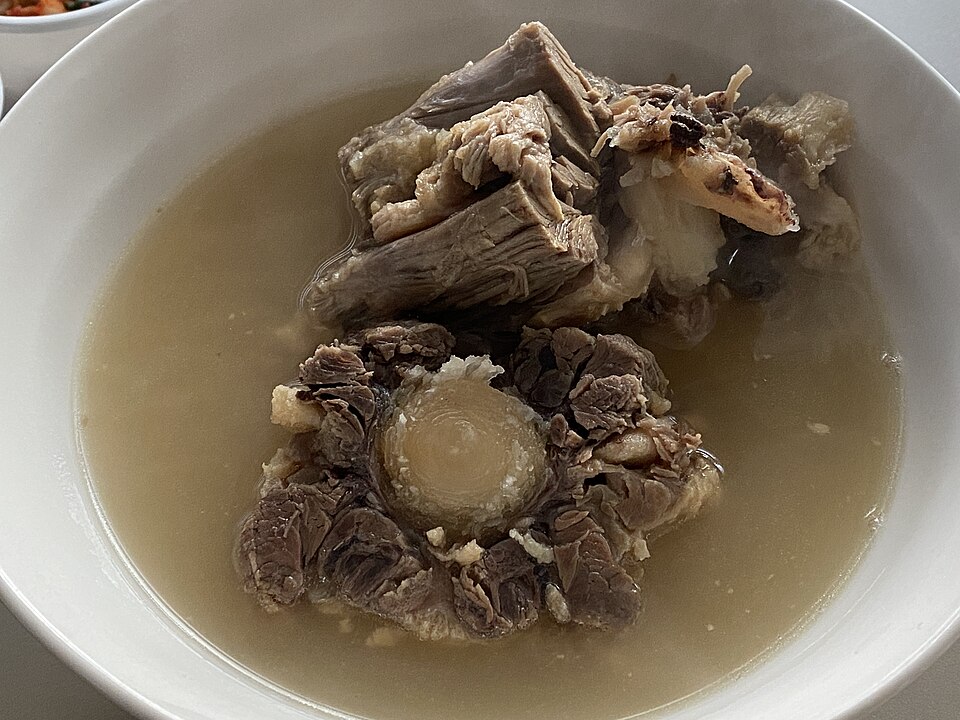
Kkori Gomtang
Kkori gomtang belongs to Korea's family of white, milky soups — alongside seolleongtang and galbitang — where the broth's opacity comes entirely from collagen and fat emulsified through hours of simmering, without a drop of milk or cream. The oxtail, otherwise a hard cut to use well, is transformed completely: the cartilage partly dissolves into the broth, giving that silky, lip-coating texture specific to collagen-rich bones. Unlike many Korean soups that are spiced from the start, kkori gomtang is served nearly unseasoned — salt and pepper sit on the table, and each person adjusts their own bowl. This simplicity lets the clean flavour of the bone speak for itself. The crucial step is patience in two stages: the long simmer that extracts the collagen, followed by the chill in the fridge that lets the solidified fat be lifted off completely — skip this and the broth stays heavy and greasy instead of silky.
Bone-in oxtail
Simmered for hours until white and creamy
Milky, opaque broth
The colour comes from dissolved collagen, not cream
Salted at the table
Each diner seasons their own bowl
Served with steamed rice
Often spooned right into the broth
Ingredients 4 servings
- 1.8 kg oxtail, cut into 5-6 cm pieces
- 500 g beef stew meat (chuck or shin), cubed
- 3.5 l water, plus cold water for soaking
- 1 large onion, halved
- 1 leek, white part only, well washed and cut into large pieces
- 8 garlic cloves, whole
- 3 cm fresh ginger, sliced
- 3 spring onions, finely chopped, to serve
- Salt and white pepper, to serve
- Steamed white rice, to serve
How to make it
- 1SOAK THE OXTAIL: put the oxtail pieces in a large bowl, cover with cold water and refrigerate 3-4 hours, changing the water 2-3 times — this draws out residual blood and gives a clearer broth later.
- 2PARBOIL THE MEAT: tip the drained oxtail and the stew meat into a large pot and pour over enough cold water to cover everything by a couple of centimetres.
- 3Bring it up to a hard, rolling boil and hold it there for 10 minutes — this rough first boil is what forces the last of the blood and impurities out as grey foam.
- 4Empty the pot into a colander, then scrub both the meat and the pot clean under the tap; any scum left clinging to either one will cloud the broth later.
- 5SIMMER THE BROTH: with everything rinsed, put the meat back in the pot, pour in the 3.5 litres of fresh water and add the onion, garlic, ginger and the white part of the leek.
- 6Bring it to a boil once more, then turn the heat down to a bare simmer, lid tilted to let a little steam escape, and leave it more or less alone for 4-5 hours; it's ready when the liquid has gone from clear to a soft, milky white and a fork slides through the meat with almost no resistance.
- 7STRAIN AND CHILL: strain the broth into a clean container, discard the softened vegetables, then refrigerate for at least 2 hours, or overnight, so the fat rises to the top and solidifies.
- 8SKIM THE FAT: lift off the solid layer of fat with a spoon and discard it — this step gives the broth a clean taste rather than a greasy one.
- 9REHEAT AND SERVE: bring the broth back to a simmer over medium heat with the meat, ladle into deep bowls, add steamed rice if you like, scatter over the chopped spring onion, and serve with salt and white pepper alongside so each diner can season their bowl to taste.
Nutritional info
per serving (~400 ml)
Estimated nutritional values.
Pairs perfectly with