Tabbouleh
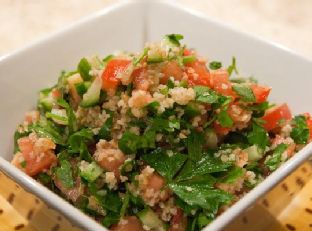
Tabbouleh comes from the mountain villages of Lebanon and Syria, where flat-leaf parsley grows in every kitchen garden. The word derives from an Arabic root meaning to spice or season, though the dish carries no heavy spicing — its character comes from the balance of raw, fresh elements. Outside the Levant it is commonly misread as a bulgur dish with parsley added; in Lebanon it is the reverse: a parsley salad with a small amount of bulgur for texture, roughly four parts parsley to one part grain by weight. The bulgur soaks in cold water for twenty minutes, then gets squeezed completely dry — it never cooks. Parsley must be chopped as finely as possible with a knife; a food processor bruises the herbs and releases a bitter liquid that ruins the texture. Every drop of moisture must be squeezed from the bulgur before dressing, or the lemon gets diluted and the salad turns soggy within minutes.
Parsley is the hero
Four parts parsley to one part bulgur by weight — this is a parsley salad, not a grain salad; if the green does not overwhelm, add more
Lemon over oil
Tabbouleh takes more lemon juice than olive oil — the acid lifts the herbs and keeps the parsley bright green rather than wilted
Knife only, no processor
A food processor bruises the parsley and releases bitter liquid that ruins the salad — chop by hand as fine as you can
Rest before serving
Ten minutes after dressing lets the bulgur absorb the lemon juice and the herbs release their oils — the salad visibly improves
Ingredients 4 servings
- 200g flat-leaf parsley, leaves only, finely chopped
- 50g fine bulgur wheat, soaked in cold water 20 min then squeezed dry
- 3 ripe tomatoes (about 300g), finely diced
- 4 spring onions, finely sliced
- 20g fresh mint leaves, finely chopped
- Juice of 2 lemons (about 80ml)
- 4 tbsp extra-virgin olive oil, salt and black pepper to taste
How to make it
- 1Soak the bulgur in cold water for 20 minutes, then drain and squeeze out as much water as possible with your hands — it should be dry, not wet.
- 2Chop the parsley as finely as you can; authentic tabbouleh is herb-forward, not grain-forward.
- 3Combine parsley, mint, spring onions, tomatoes and squeezed bulgur in a large bowl.
- 4Add lemon juice and olive oil, toss well and let rest 10 minutes — the lemon juice continues to soften the bulgur and blooms the herbs.
- 5Adjust salt and pepper.
- 6Serve at room temperature.
- 7True tabbouleh is a parsley salad with bulgur, not a bulgur salad with a little parsley.
Nutritional info
per serving (~350 g)
Estimated nutritional values.
Pairs perfectly with