Egg Tarts
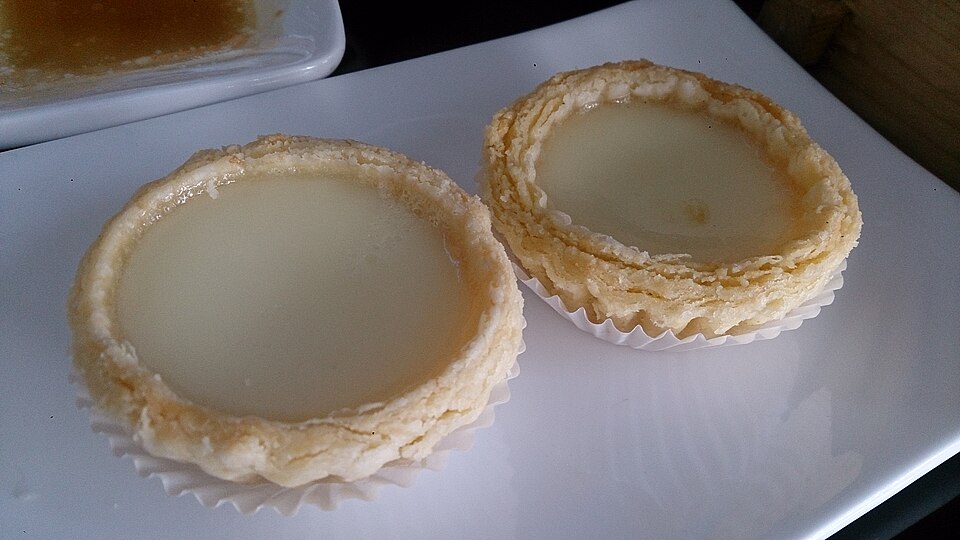
The egg tart is a hybrid creation from the former Portuguese colony of Macau, where local cooks adapted the Portuguese pastéis de nata — with its puff pastry and caramelized custard top — to Cantonese tastes, dropping the scorched surface and lightening the custard. From there the recipe passed into Hong Kong, where it became a pillar of cha chaan teng culture (Hong Kong-style diners) and a symbol of a local cuisine in its own right, distinct from both the Portuguese original and Western custard tarts. What separates a successful tart from a mediocre one comes down to a few technical details: the custard has to be strained several times to remove air bubbles, or the surface fills with dimples during baking; the initial high heat quickly sets the pastry shell, and the reduced heat afterward lets the custard coagulate gently without cracking; and the tart is pulled from the oven while the center is still slightly wobbly, since it keeps cooking from its own residual heat after coming out.
Puff pastry with thin layers, pressed into small molds
Stays crisp and flakes apart, unlike plain shortcrust
Egg custard strained through a fine sieve
Removes air bubbles, for a silky texture with no lumps
Baked at high heat, then reduced
Prevents the custard from puffing up too much and cracking on top
Served warm, with a slightly wobbly center
The custard shouldn't be fully set, just smooth and creamy
Ingredients 4 servings
- 1 pack puff pastry (450g), fridge-cold
- 150g sugar
- 180ml boiling water
- 180ml evaporated milk
- 4 large eggs, lightly beaten
- 1 tsp vanilla extract
- A pinch of salt
How to make it
- 1PREPARE THE SYRUP: dissolve the sugar in the boiling water, stirring until fully melted, then let cool to room temperature.
- 2SHAPE THE SHELLS: cut the puff pastry into squares, press each piece into a small tart mold, lifting the edges above the rim.
- 3MIX THE CUSTARD: whisk the eggs lightly with the evaporated milk, the cooled syrup, vanilla and salt, without incorporating air bubbles.
- 4STRAIN: pass the custard through a fine sieve 2-3 times, for a completely smooth texture with no lumps.
- 5FILL THE SHELLS: pour the custard into the pastry shells, up to about three-quarters of the height, so it doesn't overflow while baking.
- 6BAKE: bake at 220°C for 10 minutes, then reduce to 180°C and bake for another 10-12 minutes, until the custard sets but the center is still slightly wobbly.
- 7COOL AND SERVE: let the tarts rest 5 minutes in the mold before removing, then serve them warm.
Nutritional info
per serving (~350 g)
Estimated nutritional values.
Pairs perfectly with