Miso Soup
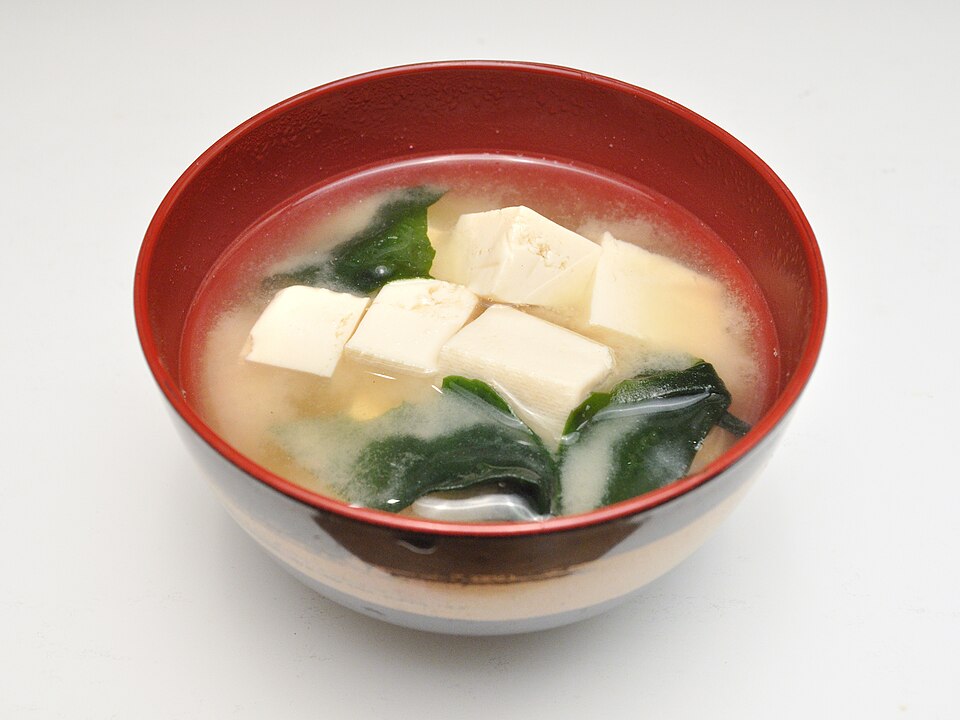
Miso soup is one of the oldest everyday Japanese dishes, with roots in the Muromachi period (14th-16th centuries), when fermented miso paste became widely accessible and was paired with dashi, the subtle broth of seaweed and dried fish that underlies almost all of Japanese cooking. Since then, miso soup has remained a fixture of the traditional Japanese breakfast and daily home meals, with regional paste variations — lighter and sweeter in the west, darker and saltier in the northeast. What separates a successful miso soup from a flat one comes down to two technical factors: the miso paste must never be boiled, since high heat destroys the complex aromas and the live fermentation culture that give it its character; and the dashi must be prepared carefully, with the seaweed removed just before boiling and the bonito flakes only allowed to settle, not boil, or the broth turns bitter and loses its clarity.
Dashi made from kombu seaweed and bonito flakes
The subtle umami base, without which the soup would taste flat
Miso paste added after the heat is off
Boiling destroys the delicate aromas and beneficial fermentation bacteria
Tofu cut into small cubes, added at the end
Stays tender, doesn't crumble or soak up too much liquid
Miso paste dissolved through a strainer
Distributes evenly, with no undissolved lumps left behind
Ingredients 4 servings
- 1 piece kombu seaweed (10cm)
- 10g bonito flakes (katsuobushi)
- 1 litre water
- 3-4 tbsp miso paste (white or mixed)
- 200g soft tofu, cut into 1cm cubes
- 2 spring onions, thinly sliced
- 2 tbsp dried wakame (optional, rehydrated)
How to make it
- 1PREPARE THE DASHI: put the kombu in cold water in a pot and let it sit 20-30 minutes, then heat over low heat, removing the kombu just before it comes to a boil.
- 2ADD THE BONITO: bring the water almost to a boil, add the bonito flakes, turn off the heat and let them settle for 2-3 minutes.
- 3STRAIN: strain the liquid through a fine sieve to get clear dashi; keep only the liquid.
- 4REHEAT: put the dashi back over low heat and add the rehydrated wakame, if using, letting it warm through without boiling.
- 5DISSOLVE THE MISO: turn off the heat, hold a small strainer over the pot with the miso paste in it and dissolve it with a spoon, pressing it gently through the mesh straight into the liquid.
- 6ADD THE TOFU: add the tofu cubes carefully, without stirring too much, so they don't crumble.
- 7SERVE: sprinkle spring onion on top and serve immediately, while the soup is hot but hasn't boiled again since the miso went in.
Nutritional info
per serving (~400 ml)
Estimated nutritional values.
Pairs perfectly with