Labneh
Labneh developed as a way to keep yogurt from spoiling in the Levant's hot climate long before refrigeration existed, since straining out the whey concentrates the yogurt's acidity and reduces its water content enough to extend its life by days or even weeks when stored under oil. The word itself comes from the Arabic "laban," meaning yogurt or soured milk, and versions of it appear under different names across nearly every country that borders the eastern Mediterranean. In Lebanon it holds a fixed place on the mezze table and, just as often, on the breakfast one, where it is scooped into flatbread alongside olives, cucumber, and mint rather than treated as a separate course. Lebanese households commonly roll surplus labneh into small balls, submerge them in jars of olive oil, and let them mature for weeks or months, a preserved form that develops a sharper, almost cheese-like flavor prized on its own, well beyond what the fresh version offers.
Yogurt strained for a full day, not an hour
Labneh is simply yogurt hung in cloth over a bowl for 12-24 hours, letting the whey drip away until what's left is thick enough to hold the shape of a spoon.
Salted before straining, not after
A pinch of salt is stirred into the yogurt before it goes into the cloth, since salting early helps draw out more whey and seasons the labneh evenly all the way through.
Served as a pool of olive oil, not a scoop
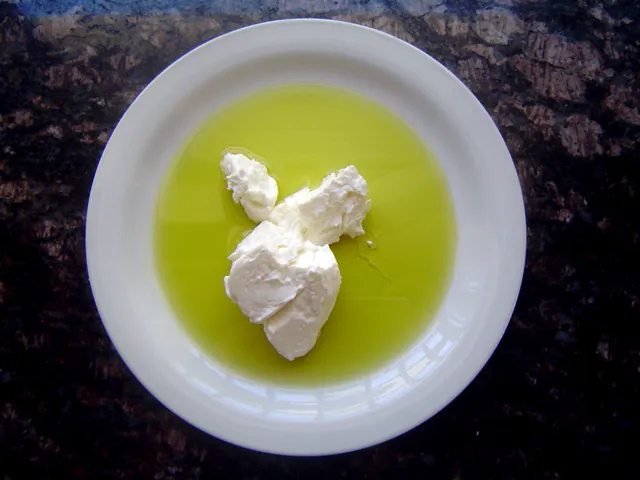
Rather than being spooned onto a plate on its own, labneh is usually spread into a shallow dish, dimpled with a spoon, and flooded with olive oil that collects in the dents.
Breakfast, mezze, and preserve, all at once
Beyond the fresh dip, labneh is often rolled into small balls and stored in olive oil, turning a breakfast spread into a pantry staple that keeps for weeks.
Ingredients 4 servings
- 1 kg full-fat plain yogurt (cow's or goat's milk)
- 1 1/2 tsp fine sea salt
- Cheesecloth or a clean thin cotton cloth
- 3 tbsp extra-virgin olive oil, for serving
- 1/2 tsp dried mint or za'atar, for serving
- 1/4 tsp sumac, for serving
- A pinch of Aleppo pepper or paprika, for serving
- Warm pita or flatbread, for serving
- A few black olives, to garnish
How to make it
- 1Stir the salt thoroughly into the yogurt until fully dissolved, since seasoning it now means you won't need to mix the finished labneh later.
- 2Line a large bowl or colander with a double layer of cheesecloth, letting plenty of excess hang over the edges.
- 3Pour the salted yogurt into the center of the cloth, then gather the corners together and tie them into a secure knot.
- 4Hang the bundle over the bowl, or set it in a colander with a weight on top, and leave it in the refrigerator for at least 12 hours, and up to 24 for a firmer result.
- 5Check occasionally to make sure the whey is dripping freely and hasn't clogged the cloth.
- 6Once it has thickened to a texture that holds a spoon shape, unwrap it and discard the collected whey, or save it for soups and bread dough.
- 7Spread the labneh onto a plate, swirl a hollow into the center with the back of a spoon, and fill it with olive oil before finishing with za'atar, sumac, or a pinch of chili.
Nutritional info
per serving (~350 g)
Estimated nutritional values.
Pairs perfectly with