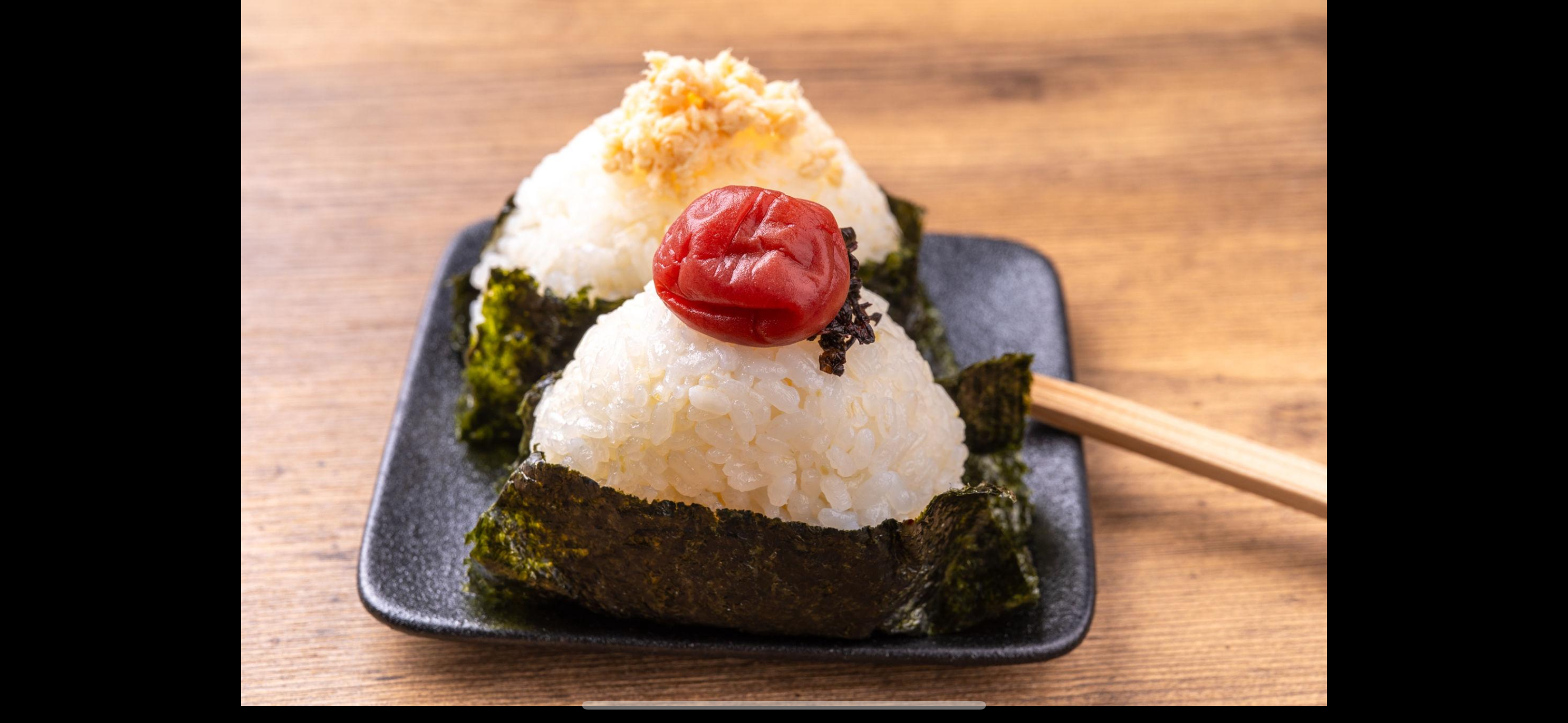
Onigiri
Onigiri are older than sushi: rice balls shaped into triangles, discs or barrels with a salted plum, grilled fish or seaweed at the centre have been packed into Japanese lunchboxes since at least the Heian period. The triangle — sanrokutai — is a practical shape: it stacks neatly in a bento box, fits the hand, and offers three flat faces for a nori strip to wrap around without slipping. The defining technique is mochizukuri — pressing the rice just enough to hold its shape without compacting it into paste. A good onigiri gives a little when you squeeze it but stays whole; a poor one is either too loose or too dense. Salt belongs on the hands rather than in the rice, so the seasoning lives on the outer skin and the grain itself stays clean.
Triangle = sanrokutai
Stacks neatly, fits the hand, takes a single nori strip cleanly
Salt on the hands, not the rice
Tezu lightly seasons only the outer skin
Shape it just warm
Too hot is hard on the hands; too cold and the rice won't bind
Nori wraps at the table
Add the seaweed just before eating so it stays crisp
Ingredients 4 servings
- 500 g Japanese short-grain rice (Koshihikari or sushi rice)
- 600 ml fresh cold water for cooking (rice to water ratio ~1:1.1)
- For the tezu (finger water): 200 ml warm water + 1.5 tsp fine sea salt
- 4 sheets toasted nori, cut into strips about 3 cm wide × the length of the sheet
- Filling option 1 — tuna mayo: 80 g canned tuna (drained), 1.5 tbsp Japanese mayonnaise, ½ tsp soy sauce
- Filling option 2 — umeboshi: 60 g pitted salted plums, lightly mashed with a fork
- Filling option 3 — shiozake (grilled salted salmon): 100 g salmon fillet grilled and flaked, with the skin removed
- Filling option 4 — okaka: 8 g bonito flakes mixed with 1 tsp soy sauce
- For plain onigiri: 2 tbsp furikake (rice seasoning), to coat the outside
- Optional: a few sesame seeds for the surface of plain ones
How to make it
- 1Rinse the rice in cold water four or five times until the water runs almost clear, drain in a strainer for 20 minutes, then cook with the 600 ml of fresh water in a heavy pot or rice cooker; once cooked, rest off the heat with the lid on for 10 minutes.
- 2While the rice rests, mash the umeboshi with a fork, mix the tuna with the Japanese mayonnaise into a creamy paste, and flake the grilled salmon — each onigiri needs only about a tablespoon of filling.
- 3Dissolve the salt in the warm water to make the tezu; this is the finger water that keeps the rice from sticking to your palms and lightly salts the outside.
- 4Tip the hot rice onto a wide tray, fluff gently with a wooden paddle and let it cool until just warm enough to handle.
- 5Wet your palms in the tezu, take about 100 g of rice in your palm, press a hollow in the centre, drop in a tablespoon of filling and gather the rice around it; cup your hand and press into a triangle with three flat faces, firm but not crushed.
- 6Wrap a strip of nori around the base of each triangle just before eating so the seaweed stays crisp; for plain onigiri, roll the outside in furikake instead.
- 7Eat at room temperature within 4 hours.
Nutritional info
per serving (~350 g)
Estimated nutritional values.
Pairs perfectly with